

SIGNAL- And Why .GOV Hates It
Guest Post by Capitalist Eric

Part of working for a large company is that you sometimes get protesters- environmentalists, Antifa, BLM and their ilk. And the large company I work for takes security seriously, and monitors for upcoming protests, and makes corresponding changes in access to facilities, monitors perimeter security of the campus, works with local law enforcement, and even hires former .gov employees to manage those security efforts. By these circumstances, I happened to attend a security briefing last month, regarding upcoming protests, given by a retired FBI manager, who apparently managed a couple of different offices on the East Coast.
The lecture was pretty standard stuff, all considered, but there came a part of the presentation when he was discussing the security efforts for monitoring said groups. First bullet-point was that they used the app known as “Signal.” He went further to explain that they had no way to crack it, no matter what they tried, so they didn’t even bother to. Second point was that the work-around was to get infiltrators into said organizations, who (unlike the FBI agents who instigated the Governor Whitmer kidnapping “plot”) would pretend to be loyal supporters, always supporting the cause, mouthing the platitudes but otherwise not doing anything to arouse suspicion that the insiders were actually moles. They would do what was necessary to become part of all key leaderships comms channels on Signal, so the FBI could have a direct pipeline to all communications and planning efforts.

At one point he was flat-out laughing, saying that they had more agents inside the leadership comms channels than actual members of the respective groups, and they didn’t have a clue.
This presentation, and other discussions, started me down the rabbit-hole, to learn more about the actual .gov surveillance efforts of groups that might pose a threat the .gov agenda. It also made me question why Signal was considered “unbreakable” to the FBI (or more accurately, the NSA), and whether this was in fact true.
And finally, it made me realize that everyone needs to understand this subject, so as to have secure, PRIVATE communications, and why it matters.
BIG BROTHER IS WATCHING…
To begin with, everything you do using the internet or cell phones, is recorded and stored at NSA data centers, like the Utah one below:

Now, you may say, “what do I care, I’m not doing anything illegal!” The problem is that Joe Biden (spit!) has designated that anyone who doesn’t toe the line- especially on subjects such as the Afghanistan withdrawal, the Russia/Ukraine conflict, COVID or stolen elections- is a domestic terrorist, and is subject to prosecution. That means if they pick you out of the crowd of people discussing these subjects – for any reason or no reason at all- you have no rights. NONE. In summary, anyone who the government targets can expect no better treatment than the detainees of Gitmo. This is why the J6 defendants are horribly treated, and railroaded in sham trials; they have no rights.
According to the ACLU,
The NSA intercepts and copies private communications in bulk while they are in transit, and then searches their contents using tens of thousands of keywords associated with NSA targets. These targets, chosen by intelligence analysts, are never approved by any court, and the limitations that do exist are weak and riddled with exceptions.
This is done as part of Section 702 of the Foreign Intelligence Surveillance Act, or FISA. The operational program is called “Prism,” and was revealed by Edward Snowden in 2013.
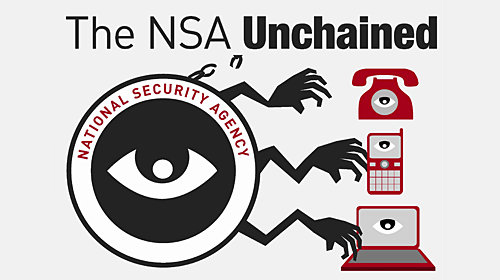
This is possible because computer memory is cheap; a 20 Terabyte computer hard drive can be had for $360 currently at Amazon. The US government has taken advantage of the cheap memory, and built multiple NSA spy data centers in Hawaii, Colorado, Texas, Georgia, and Maryland, all interconnected by dedicated fiberoptic lines in a single, secure data cloud. The data-storage capabilities of these facilities are staggering, as this article details of the Utah facility:
This data-storage facility for the US intelligence community is designed to store data estimated at over a zettabyte, though its actual capacity is classified. Its purpose is to support the Comprehensive National Cybersecurity Initiative. A zettabyte (ZB) is 1,000 exabytes (EB). Each EB is equal to 1,000 petabytes (PB). A PB is equal to 1,000 terabytes (TB). The average personal computer today has a capacity of 1 TB with a ZB of data representing 100 million personal computers’ data capacity.
Additionally, the total amount of data created, captured, copied, and consumed globally is forecasted to increase rapidly, from 64 ZB in 2020 to more than 180 ZB by 2025—a far cry from the 2 ZB created in 2010.
How Are Large Amounts of Data Managed?
The huge amount of data can only be searched by the powerful, water-cooled HPE/Cray supercomputers at the data center. All these systems require 65 megawatts of electricity, costing about $40 million per year. The facility is estimated to use 1.7 million gallons of water per day for cooling both the supercomputers and the servers that store the data on solid-state drives. Solid-state drives have no moving parts and use a fraction of the power and water for cooling that spinning-disk hard drives require.
READ MORE HERE
Share This Story, Choose Your Platform!

About the Author: Patriotman

5 Comments
Comments are closed.


GUNS N GEAR


I don’t know the author but am reminded of the saying “you are not paranoid if they really are out to get you”.
Very informative. Thanks for posting this.
My fellow conservatives, stop taking tech advice from people who sell sat phones and scream about “AI beINg iN EvErYThIng.”
To be honesty though, are people seriously this behind the curve? They can’t be. This shit is fucking simple. It’s not even remotely complicated.
Interesting article in that word was going around in 2020-21 that Signal was NOT secure and thus my little band was discouraged from communicating on it and to just monitor chats. Might be more to it as Ive no claim to tech savy, but interesting all the same.
Signal being secure/not-secure requires a somewhat nuanced answer…..the encryption cipher and implementation with forward secrecy is “secure” (this is of course predicated on the code continuing to be open-source and auditable). The larger concern with the Signal model is lack of anonymity (phone number required for registration) and relationship mapping, which is solid gold in the intel world. Not to mention the whole human aspect, which would broadly apply to pretty much any messenger, ie a bad actor getting onto the channel or “shoulder surfing” you, etc. Security is a serious game…..
.gov cyber units use it.