
‘Built extremely quickly’: New China pics making experts sweat
It’s long been considered the final “red flag” for Beijing’s intentions to invade Taiwan.
Now, satellite photos have revealed the construction of a new fleet of D-Day-style landing barges needed to surge troops and tanks over a beach.
Naval analyst H I Sutton has published a report in Naval News highlighting the appearance of between three and five new “special and unusual” barges at Guangzhou Shipyard in southern China.
Such barges should not be “special” or “unusual”.

In fact, they are a relatively ordinary sight at riverside and coastal construction projects.
But these particular barges at the Chinese dual-use civilian-military construction facility don’t fit that profile.
“The barges are reminiscent of the Mulberry Harbours built for the allied invasion of Normandy during World War II,” Sutton observes.
“Like those, these have been built extremely quickly and to novel designs.”
China is building at least five new special purpose barges which appear tailor made for amphibious assault. The barges may provide the PRC with a unique way to offload large numbers of tanks directly onto Taiwanese roads 🇨🇳 🇹🇼
By @CovertShoreshttps://t.co/Je3K6BT3jG— Naval News (@navalnewscom) January 10, 2025
The Chinese Communist Party (CCP) in Beijing has, for the past decade, been steadily ramping up tensions against the 23 million-strong island democracy sitting just off its shores.
Taiwan became the last bastion of the autocratic Republic of China’s government and military after Chairman Mao Zedong’s Communist revolutionary forces seized control of the mainland in 1949. The island has since transitioned to a democracy, but the CCP insists it is part of its territory.
“With the sacred mission of defending national sovereignty and territorial integrity on its shoulders, the Chinese PLA (People’s Liberation Army) will resolutely smash any ‘Taiwan independence’ separatist attempts and thwart any foreign interference,” Chinese Defence spokesperson senior colonel Wu Qian said late last year.
Chairman Xi Jinping has made it a central platform of his unprecedented three-term administration to enforce “the historical trend of China’s reunification” – whether Taiwan wants it or not.
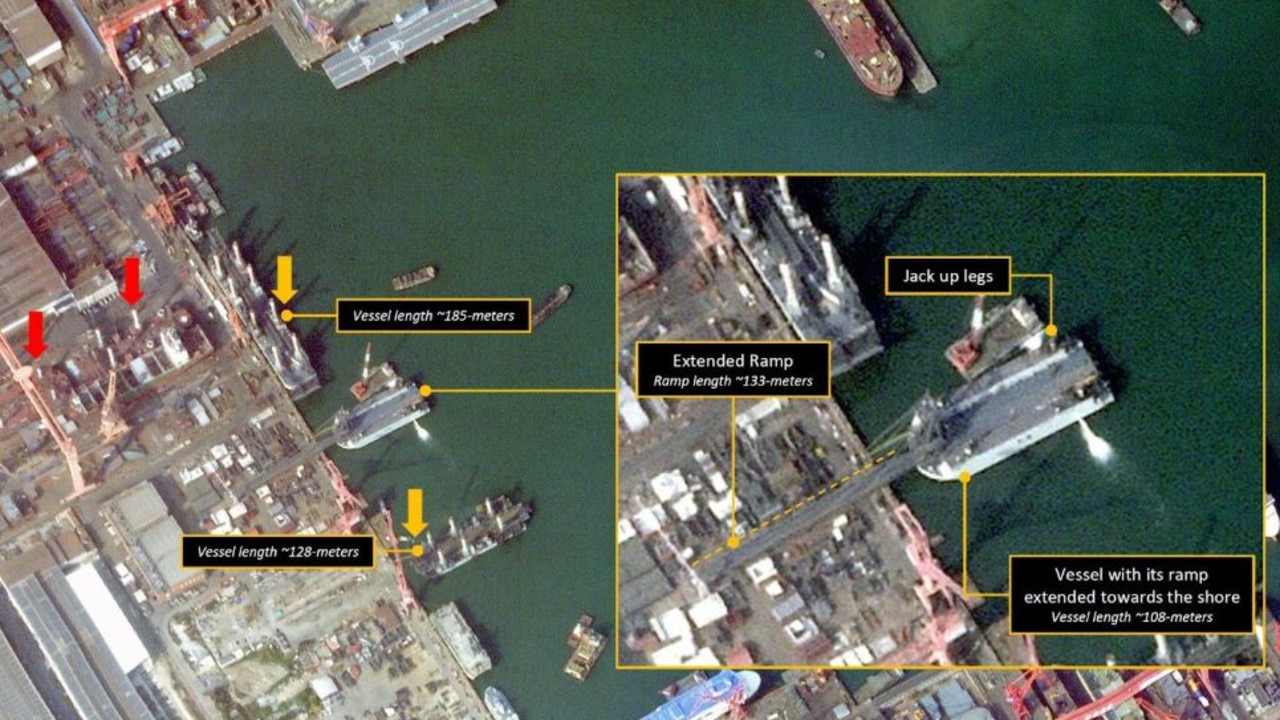
New satellite photos have revealed the construction of a new fleet of D-Day-style landing barges needed to surge troops and tanks over a beach. Picture: @AllSourceA/X
“Beijing is now contemplating one of history’s most ambitious amphibious operations, including the largest-ever civilian ship mobilisation – greatly exceeding the Dunkirk evacuation in ship numbers and the Falklands War in tonnage,” warns US Naval War College professor Andrew Erickson.
But invading the rugged island is no simple task.
Only a few beaches are firm and clear enough to carry an invasion force. And these are already heavily defended.
That’s where the new barges come in: They are essentially self-deploying jetties.
“These have unusually long road bridges extending from their bows,” Sutton notes.
“This configuration makes them particularly relevant to any future landing of PRC (People’s Republic of China) forces on Taiwanese islands.”
Mulling harbours on stilts
The Naval News report analysis of satellite photos indicates the new barges carry a 120m long bridge, braced by a tower and high-tension cables.
At the other end of the barge is a loading platform that can allow other ships or landing craft to dock. And several of the barges appear to have pylons that “jack up” the vessel from the sea floor to turn it into a stable harbour platform even in rough seas and strong winds.
“In operation, the barge would act as a pier to allow the unloading of trucks and tanks from cargo ships,” Sutton explains.
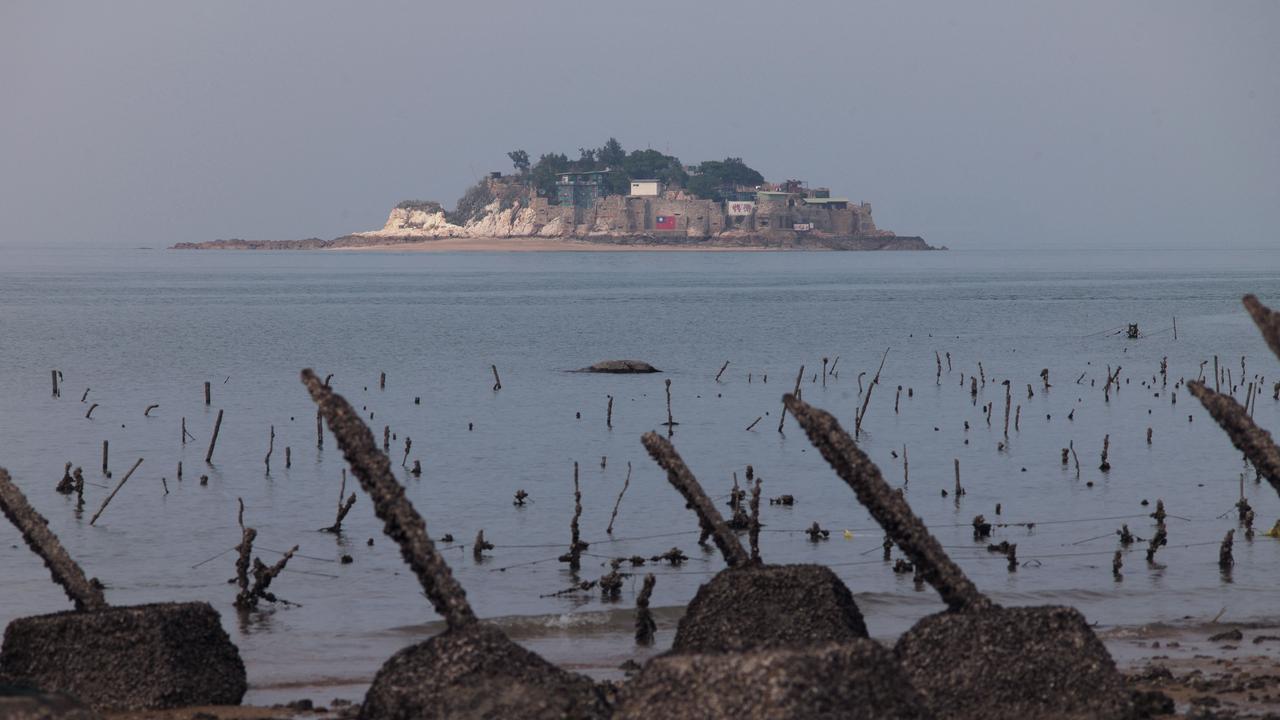
Taiwan’s remote Shihyu islet, as seen from behind the the anti-landing spikes on Taiwan’s frontline island of Little Kinmen. Picture: by Sam Yeh/AFP
“This allows China to pick new landing sites and complicate attempts to organise defences. Instead of relying on Taiwanese ports, China can now sail its own mobile port across the straits.”
What makes these new barges so important is the ruggedness of Taiwan’s coast. Those few beaches that do exist have long been filled with steel spikes and tank-traps, and can be mined with explosives as tensions escalate.
The extreme reach of the barges’ bridges means Chinese forces can cross to the shore at sites previously regarded as unsuitable for invasion forces.
Other strategists agree.
Analysis of GEOINT on 08 January 2025 shows new possible amphibious operations support vessels at the Guangzhou shipyard in China. https://t.co/epfzHD3Daa
Spotlight Report – Critical intelligence delivered to your inbox. https://t.co/n0XDPQMZj2#GEOINT#China#Guangzhoupic.twitter.com/EElgZv2rM2
— AllSource Analysis (@AllSourceA) January 10, 2025
“If you wanted to be ready to have the option to invade Taiwan in 2027 per Xi’s direction, this is the sort of thing that you’d do,” says naval analyst Tom Shugart.
China’s military has dedicated military helicopter assault ships and dock-ships able to put the initial invasion force ashore while under fire. But not enough to deploy follow-up reinforcements.
READ MORE HERE
Share This Story, Choose Your Platform!

About the Author: Patriotman

Related Posts


Howitzer Clothing – Code AP15 for 15% OFF


