

Global Food Supply at Risk: The Silent Collapse Triggered by Fertilizer Shortages
Guest Post by John Walter
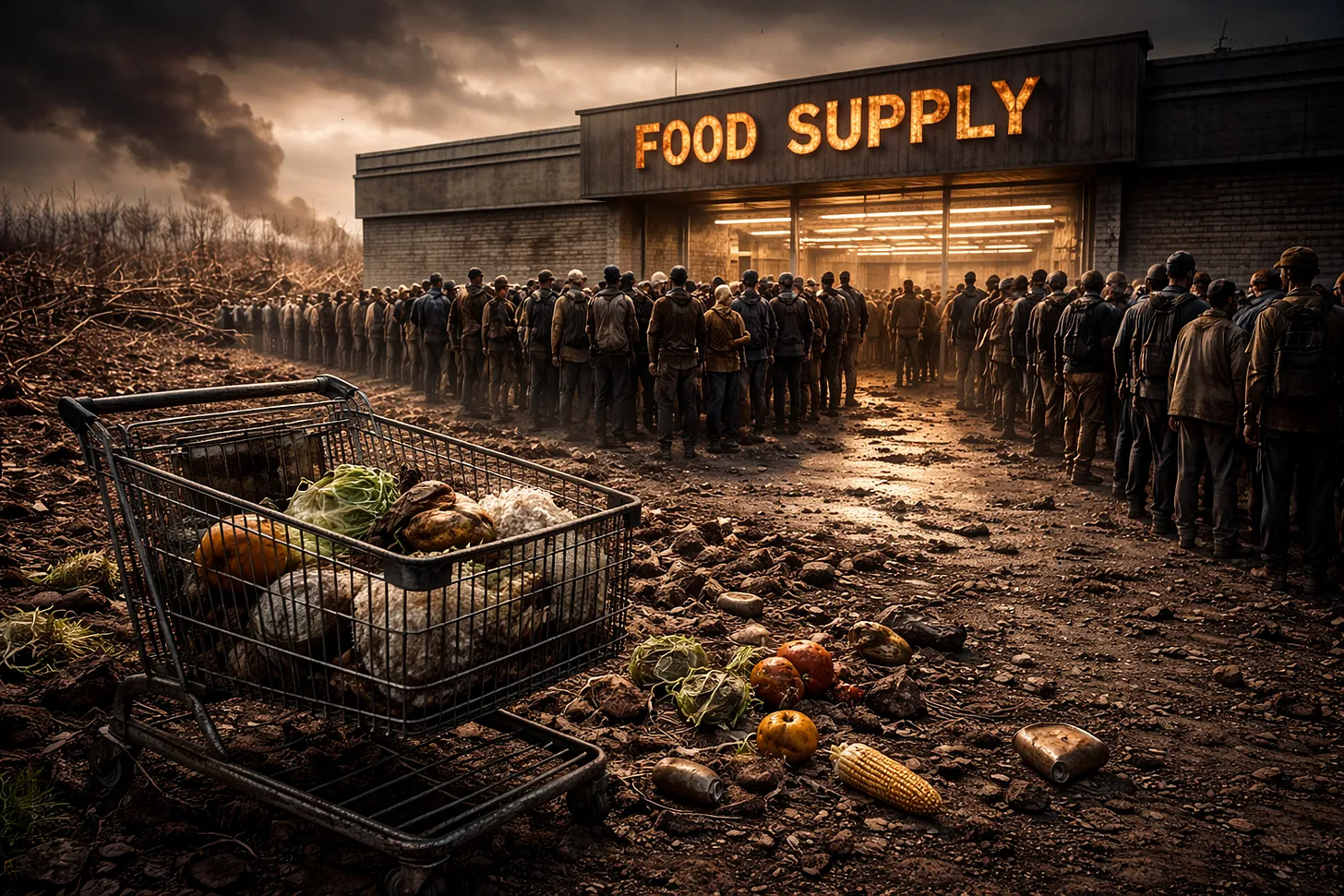
A Fragile System Built on Invisible Inputs
The modern global food system, often perceived as vast, resilient, and technologically advanced, rests on a surprisingly fragile foundation—fertilizers. These chemical inputs, largely invisible to the average consumer, sustain nearly half of global food production. Without them, the abundance of supermarkets, the predictability of harvests, and the stability of food prices would rapidly unravel.
Recent disruptions in fertilizer supply chains, intensified by geopolitical conflict, energy crises, and trade fragmentation, are exposing just how precarious this foundation truly is.
What makes the situation particularly alarming is not merely the shortage itself, but the interconnected web of dependencies it reveals. Fertilizers depend on natural gas. Global trade depends on chokepoints. Agricultural productivity depends on timing. When one element falters, the entire system begins to tremble.
And today, it is not just trembling—it is beginning to fracture.
The Anatomy of a Crisis: Why Fertilizers Matter More Than Ever
To understand the magnitude of the threat, one must first grasp the scale of dependence:
- Roughly 50% of global food production relies on synthetic nitrogen fertilizers
- Fertilizer costs account for up to 25% of total agricultural production expenses
- Global fertilizer prices surged 18% in 2025 alone, remaining above pre-pandemic levels
These are not marginal inputs—they are the backbone of industrial agriculture.
Yet, the supply of fertilizers is uniquely vulnerable due to:
- Energy dependence (especially natural gas for nitrogen fertilizers)
- Geopolitical concentration (key exporters clustered in unstable regions)
- Logistical chokepoints (notably the Strait of Hormuz)
Recent events have demonstrated how quickly these vulnerabilities can cascade into crisis.
A Perfect Storm: War, Energy, and Supply Chain Collapse
In 2026, escalating conflict in the Middle East has triggered one of the most severe disruptions to fertilizer markets in recent history. The Strait of Hormuz—through which a significant share of global fertilizer inputs passes—has become a bottleneck of global consequence.
- Urea prices have surged dramatically, in some cases rising over 47% since the conflict escalated
- Nearly 50% of global urea exports transit this chokepoint
- Tanker traffic has dropped by more than 90% in extreme scenarios, threatening systemic supply shocks
At the same time:
- Natural gas prices—essential for fertilizer production—have spiked
- Major exporters such as China and Russia have restricted exports
- Insurance and shipping risks have slowed global trade
The result is a cascading failure across agricultural systems worldwide.
Farmers, already operating on thin margins, are now faced with impossible choices:
- Apply less fertilizer and risk lower yields
- Switch crops to less input-intensive varieties
- Or, in extreme cases, abandon planting altogether
The Human Cost: Hunger, Inflation, and Global Inequality
The consequences of fertilizer shortages extend far beyond farms. They ripple through entire economies and societies, disproportionately affecting the most vulnerable.
Recent projections and warnings are stark:
- Up to 45 million additional people could face acute hunger due to rising costs and disruptions
- Developing nations, heavily reliant on imports, face the greatest risks
- Food prices are expected to surge globally, affecting staples like wheat, rice, and maize
In many regions, the crisis manifests in subtle but devastating ways:
- Farmers selling produce at 50% below normal prices due to logistical disruptions
- Reduced planting leading to future supply shortages
- Governments imposing export bans to protect domestic markets
These reactions, while understandable, often worsen the global situation by fragmenting already strained supply chains.
READ MORE HERE
Share This Story, Choose Your Platform!

About the Author: Patriotman


GUNS N GEAR


