
Projectiles Hit Two Supertankers Exiting Hormuz As Brent Tops $92, Diesel Crack Breaches $100
Two oil supertankers were struck by unknown projectiles while transiting the Strait of Hormuz early Tuesday, signaling yet another sharp escalation in hostilities along the world’s most critical energy chokepoint.
The attacks follow President Trump’s warning Monday that additional strikes against Iran remain possible. Traders are pricing in a further war risk premium, pushing Brent crude futures above $92 a barrel, while US diesel crack spreads have breached the critical $100-a-barrel threshold.
Maritime security consultant Marisks reports that Saudi shipping giant Bahri’s VLCC Sidr was hit northeast of Khasab, Oman. The Sinokor-operated Senegal Prosperity was reportedly struck by three projectiles farther east. Both tankers were exiting the maritime chokepoint.
UK Maritime Trade Operations separately confirmed that a tanker completing an outbound transit of Hormuz reported three projectile strikes but did not identify the vessel.
Brent crude futures ripped higher during Asian and European trading on the news, with the benchmark firmly above $92 as of 0600 ET.

“President Donald Trump warned Monday that further strikes are possible, pushing Brent back above $91/bbl and driving another bear-steepening move across global bond markets,” UBS analyst George Redman wrote earlier.
US diesel crack spreads were above $100 as of 0600 ET.
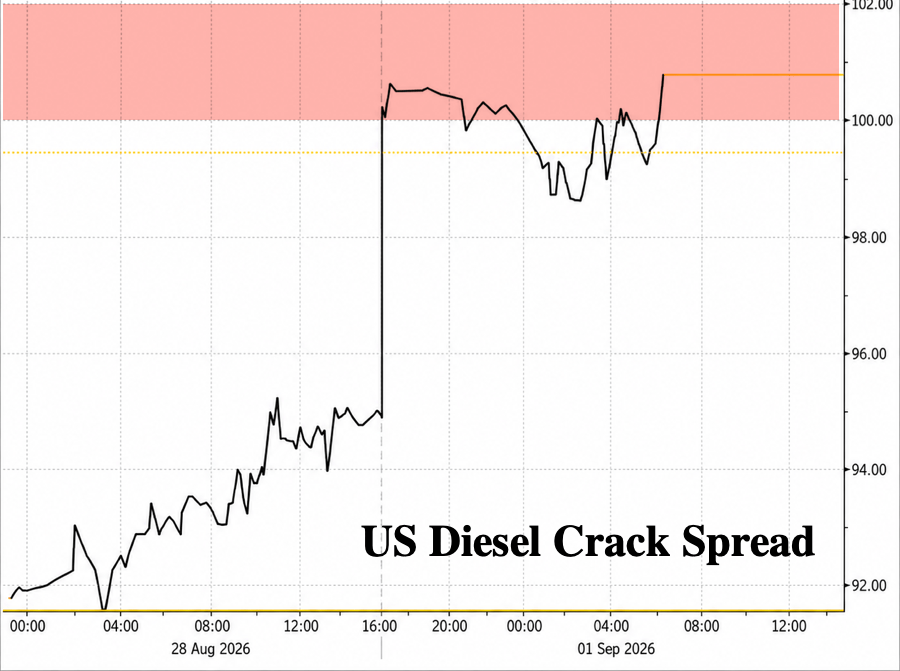
As we’ve extensively detailed, the energy crisis is not necessarily in crude itself but in refined products. Gulf diesel and gasoline shipments have declined amid disruptions in the Strait of Hormuz, while damage to Russian energy infrastructure from Ukrainian one-way attack drones has created a perfect storm in global refining markets in late summer.
Goldman’s energy expert Daan Struyven warned in his most recent note that “diesel is at the epicenter of the supply squeeze.”
“Rising strikes on refineries in the Middle East and Russia have further constrained already-stretched global refining capacity, pushing refined-products margins to new highs,” Struyven and Yulia Zhestkova Grigsby wrote in the note, adding, “Diesel remains at the epicenter of the rally.”
Struyven and his team estimate that global refinery runs are down 7 million barrels per day from last year and have averaged nearly 6 million barrels per day below seasonal norms since March, around the time the US launched Operation Epic Fury and Ukraine ramped up one-way drone attacks against Russia’s energy infrastructure.

Meanwhile, there may be some diplomatic traction in the Gulf area, with Iranian President Masoud Pezeshkian saying on state TV: “I state unequivocally that should the US return to its commitments under the aforementioned Memorandum of Understanding, the Islamic Republic of Iran will also take reciprocal action immediately.”
Treasury Secretary Scott Bessent’s “Operation Economic Outcast” is also ramping up as the Trump administration deploys sanctions to pressure Tehran into submission.
Share This Story, Choose Your Platform!

About the Author: Patriotman


Howitzer Clothing – Code AP15 for 15% OFF


