
America’s Insolvency Is Mandatory
In October, the U.S. national debt reached $31 trillion, and the government is projected to wade another trillion dollars into the red in the 2023 fiscal year. The longer-term picture is even gloomier, with the deficit expected to double to $2 trillion by 2030.
Indeed, the longer the horizon, the worse things get. At 98% of Gross Domestic Product, the current national debt is the highest it’s been since just after World War II. On its current course, the debt will soar to 185% of the country’s entire economic output by 2052.
What’s particularly troubling is that the government’s 2022 $1.3 trillion-dollar deficit came at a time of near-record tax intake. At 19.8% of GDP, Uncle Sam’s 2022 tax haul was close to the all-time high of 20.5% set in 1944.
Washington doesn’t have a revenue problem — it has a spending problem.
What few people realize, however, is the extent to which the U.S. government’s disastrous trajectory is on autopilot, thanks to the fact that an ever-larger proportion of federal spending happens without Congressional action.
To understand why, it’s important to first understand that there are two main categories of government spending:
- Discretionary spending, which requires a vote by Congress as part of the annual appropriations process.
- Mandatory spending, which is dictated by previously-enacted laws and thus happens without an annual vote in Congress. Social Security, Medicare and Medicaid comprise a big majority of mandatory spending.
Here’s where things have taken an ominous turn. In 1965, mandatory spending accounted for 34% of all federal spending. Today, that share has more than doubled, with mandatory spending representing 71% of federal outlays. With overall spending higher too, mandatory spending is much larger slice of a larger pie.
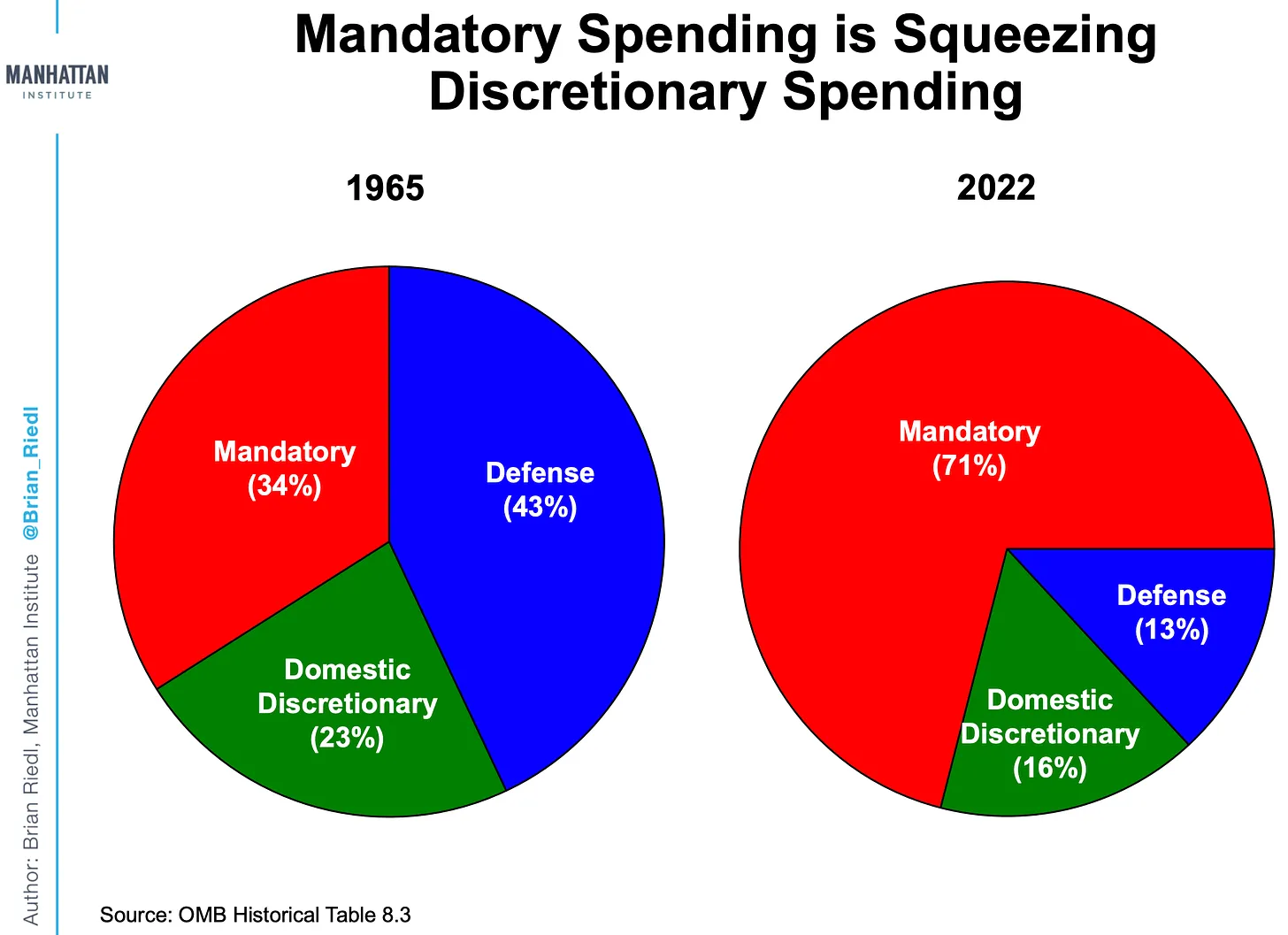
As much as it’s right to spotlight wasteful discretionary spending — like a $2.4 million National Science Foundation grant to promote dinosaur enthusiasm or $11.3 million to tell Vietnamese people to stop burning trash — the truth is that the annual budgeting process offers federal legislators a shrinking opportunity to make meaningful fiscal course corrections.
READ MORE HERE
Share This Story, Choose Your Platform!

About the Author: Patriotman

2 Comments
Comments are closed.
Related Posts


Howitzer Clothing – Code AP15 for 15% OFF


The annual Treasury Accounting office report from 2019 put the Liabilities at over 70 trillion per Paul Craig Roberts..this is basic H.S. math. According to the report I read…..WTF guys, insane meth clownworld s Gay analysis persists. Is the fact that we were insolvent back in the late 1990s , and subsequently Defaulted back then so unacceptable to say ! arguing fantasy numbers and other lude points like on the proverbial hamster wheel all the Effing Distracted time
^ what plankmember said–ALL TRUE.
it’s gonna get real “frisky” when everyone is flush with green fiat greenbacks, BUT the double-whammy of: 1) prices through the roof due to hyper-inflation and/or 2) basic items like food, water, utilities are just not there –unavailable.
PREPARE NOW or face consequences.
gather ye ‘hard assets’ while ye may –food, water, firearms, ammo, med supplies, batteries — forget the latest-and-greatest electronic gizmo being shoved down your throat. you can go days without food, only a few hours without H2O.
2,000 calories and one gal of potable water per person–AND don’t forget the livestock and pets.